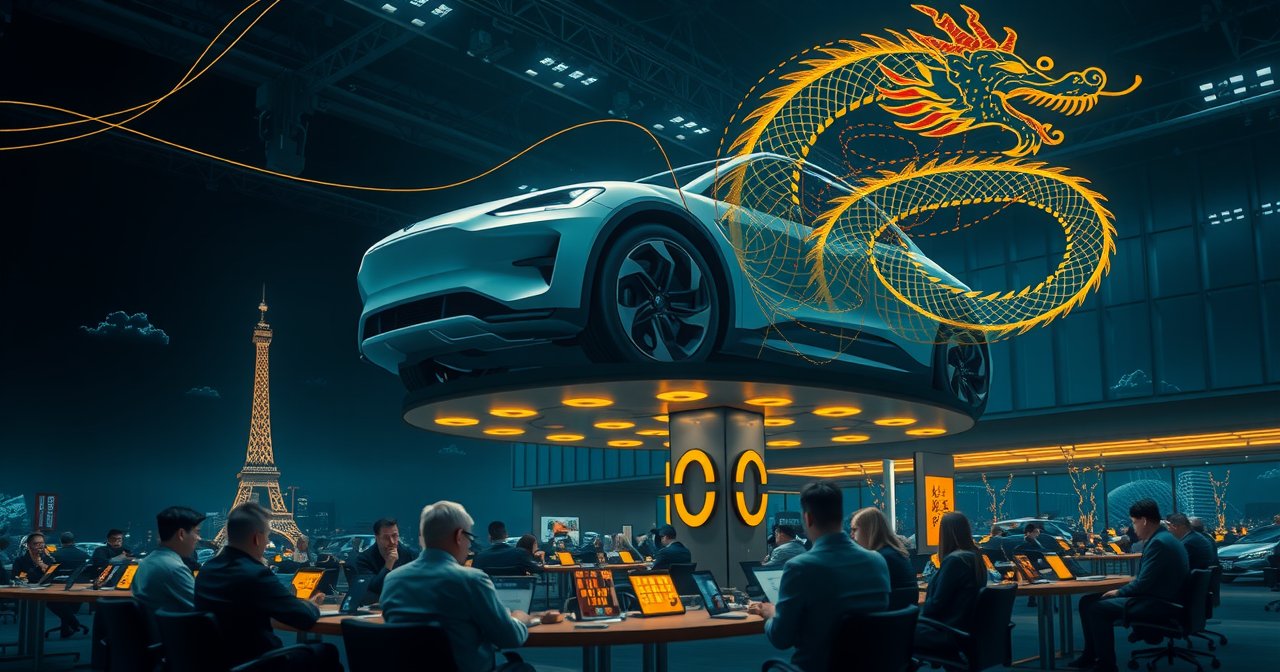
European Automakers Hand Thermodynamic Engineering Talent to Chinese Competitors

The narrative in European boardrooms over the past four years was clean, definitive, and well-received by capital markets: internal combustion was a legacy technology, battery electric vehicles (BEVs) would achieve total dominance by 2030, and the capital expenditure supporting gasoline and diesel powertrains should be zeroed out.
Then the subsidies vanished.
Across Germany, France, and Scandinavia, the removal or reduction of state purchase incentives exposed the underlying physics of the market. Without public funds artificially subsidizing high upfront vehicle costs, consumer uptake of pure BEVs stalled against hard constraints: grid limitations, cold-weather range degradation, and inadequate charging infrastructure. Automakers that had staked their corporate communications on an irreversible EV transition suddenly found themselves scrambling to keep assembly lines running by extending the lifespans of their internal combustion and plug-in hybrid electric vehicle (PHEV) architectures.
Yet, on the development floors, a quieter, more structural crisis is playing out. The veteran engineers who spent thirty years extracting marginal thermal efficiency gains out of combustion chambers are no longer there. They have been hired by Chinese automakers.
Whose Interests Were Served?
To understand this dynamic, look past the stated commitments to sustainability and examine how capital was allocated.
Internal combustion engine (ICE) development is an exercise in empirical thermodynamic trade-offs: casting metallurgy, fluid dynamics inside the cylinder, high-pressure direct injection spray optimization, and aftertreatment catalyst chemistry. It is inherently labor-intensive and slow to amortize. To European management teams navigating public equity markets, this engineering base was viewed as a heavy, fixed operational cost that depressed return on invested capital (ROIC) multiples.
By announcing an aggressive, total sunset for ICE, executives accomplished an immediate balance-sheet objective: they reallocated capital expenditure toward software and battery supply contracts, presenting their organizations to institutional investors as asset-light technology plays. The short-term beneficiaries were clear: corporate leadership defending share price multiples and institutional funds managing ESG-mandated portfolios.
The buyers on the other side of this trade were companies like Geely, BYD, and Chery.
Chinese OEMs observed the same physical constraints that Western management chose to discount. Recognizing that full electric adoption in non-urban and cold-climate regions faced severe thermodynamic and infrastructural bottlenecks, Chinese manufacturers aggressively pushed extended-range electric vehicles (EREVs) and high-efficiency PHEVs.
Developing a dedicated hybrid engine capable of exceeding 40% to 45% brake thermal efficiency from a blank sheet typically requires fifteen to twenty years of trial-and-error empirical testing. By establishing European R&D outposts and offering premium compensation packages to veteran European powertrain specialists, Chinese OEMs bypassed two decades of capital expenditure. They acquired decades of high-precision thermodynamic know-how at the marginal cost of executive payroll.
The European side discarded an expensive fixed asset; the Chinese side acquired institutional memory at zero depreciated book value.
The Mechanism of Timing: Why Now?
The intellectual debate over electrification has existed for over a decade. The reason this talent migration is surfacing now is that operating margins hit an unyielding limit.
Automotive assembly plants operate on razor-thin operating leverage. If capacity utilization falls below roughly 75% to 80%, fixed overhead consumes operating margins. When consumer demand for €50,000+ pure BEVs hit a ceiling, European OEMs were forced to rely on their legacy ICE and hybrid platforms to generate the operational cash flow needed to subsidize their unprofitable EV segments.
However, engines cannot simply be kept in production on “autopilot.” Upcoming regulatory frameworks, such as Euro 7 emissions standards, demand precise particulate filtration, rapid catalyst light-off, and sophisticated real-world emissions compliance.
Having systematically dismantled ICE departments, offered early retirement packages, and directed younger talent exclusively toward battery management systems, European automakers now face a stark operational bottleneck: they must adapt legacy platforms to survive the next decade, but the human capital required to run the engine dynamometers and map fuel calibrations is gone.
Re-hiring that expertise or relying on external engineering consultancies introduces severe friction, lengthening development cycles and increasing cash bleed.
Grounding in Physics and Unit Economics
From my vantage point as an automotive powertrain systems engineer, viewing powertrain R&D as a fungible set of digital assets misreads physical reality.
Software algorithms can be copied, re-compiled, and deployed instantaneously. Thermodynamics cannot. The behavior of an aluminum alloy under cyclical thermal stress at 2,000 RPM, the boundary-layer quenching of a flame front inside a combustion chamber, and the acoustic attenuation of a torsional vibration cannot be fully derived from finite-element simulation alone. They require tacit knowledge—the physical intuition developed over decades of watching components crack on test benches.
When a Chinese automaker designs an EREV, they treat the internal combustion unit not as a primary driver, but as a steady-state thermal generator. This requires an engine optimized for an extraordinarily narrow RPM band, pushing thermal efficiency toward theoretical limits while stripping away unnecessary weight and mechanical complexity.
By hiring engineers who spent their careers optimizing these precise parameters for premium German brands, Chinese firms have collapsed their design-to-production cycles from 48 months to under 24 months. The capital efficiency of this transfer is asymmetric: a team of twenty senior propulsion engineers costs a few million dollars annually, but saves hundreds of millions in wasted prototyping and failed certification runs.
Falsification Conditions
This structural analysis is wrong if the following data points emerge over the next 36 to 48 months:
- Next-generation solid-state or ultra-high-density cell chemistry reaches commercial volume manufacturing at pack-level costs below $60/kWh. If battery costs drop to this threshold while maintaining high charging throughput across sub-zero temperatures, the consumer value proposition of PHEVs and EREVs collapses, rendering hybrid powertrain engineering obsolete.
- European legacy automakers successfully license or insource high-efficiency hybrid powertrains from domestic Tier-1 suppliers without suffering margin compression or losing Euro 7 compliance. If domestic supply chains absorb the engineering gap without inflating vehicle unit costs, the talent drain remains an isolated human resources issue rather than a structural transfer of industrial capability.
Given current raw-material supply constraints, lithium processing yields, and the physical scaling realities of solid-state manufacturing, the probability of the first condition materializing within five years is low.
The Structural Shift
The outcome of this process is not speculative; the value flows are already established.
European premium brands will increasingly be forced into pragmatic compromises: licensing hybrid architectures, outsourcing combustion engine manufacturing, or entering joint ventures with the very Chinese competitors they sought to outpace. The venture between Renault and Geely (Horse) is an early indicator of this institutional realignment.
The net losers are the mid-tier European automotive supply chains—precision machining, casting foundries, and thermal-management suppliers across Germany, Italy, and Central Europe—whose technological moats are being hollowed out. The beneficiaries are Chinese original equipment manufacturers and hybrid component suppliers, who now control both the low-cost electrochemical supply chain (LFP cells) and the high-efficiency thermodynamic assets needed to dominate the global transitional market.
This dynamic alters where value accrues across the sector:
- Capital Goods and Auto Suppliers: Pressure on European industrial valuations dependent on combustion supply chains; expanding addressable markets for integrated Asian hybrid powertrain providers.
- Commodity Dynamics: Prolonged structural demand for the platinum-group metals (PGMs) required for hybrid catalytic converters, conflicting with consensus projections that predicted an immediate demand cliff.
When corporate planning ignores the physical constraints of cost, infrastructure, and thermodynamics, the market extracts a price. European automakers attempted to manage a transition through public declarations. In doing so, they transferred decades of hard-won physical capability to their direct competitors.
— Garryu
Source: EV化を急いだ欧州車載エンジニアが中国に買われる構造の正体 | 日本経済新聞 https://www.nikkei.com/article/DGXZQOLC243QO0U6A920C2000000/